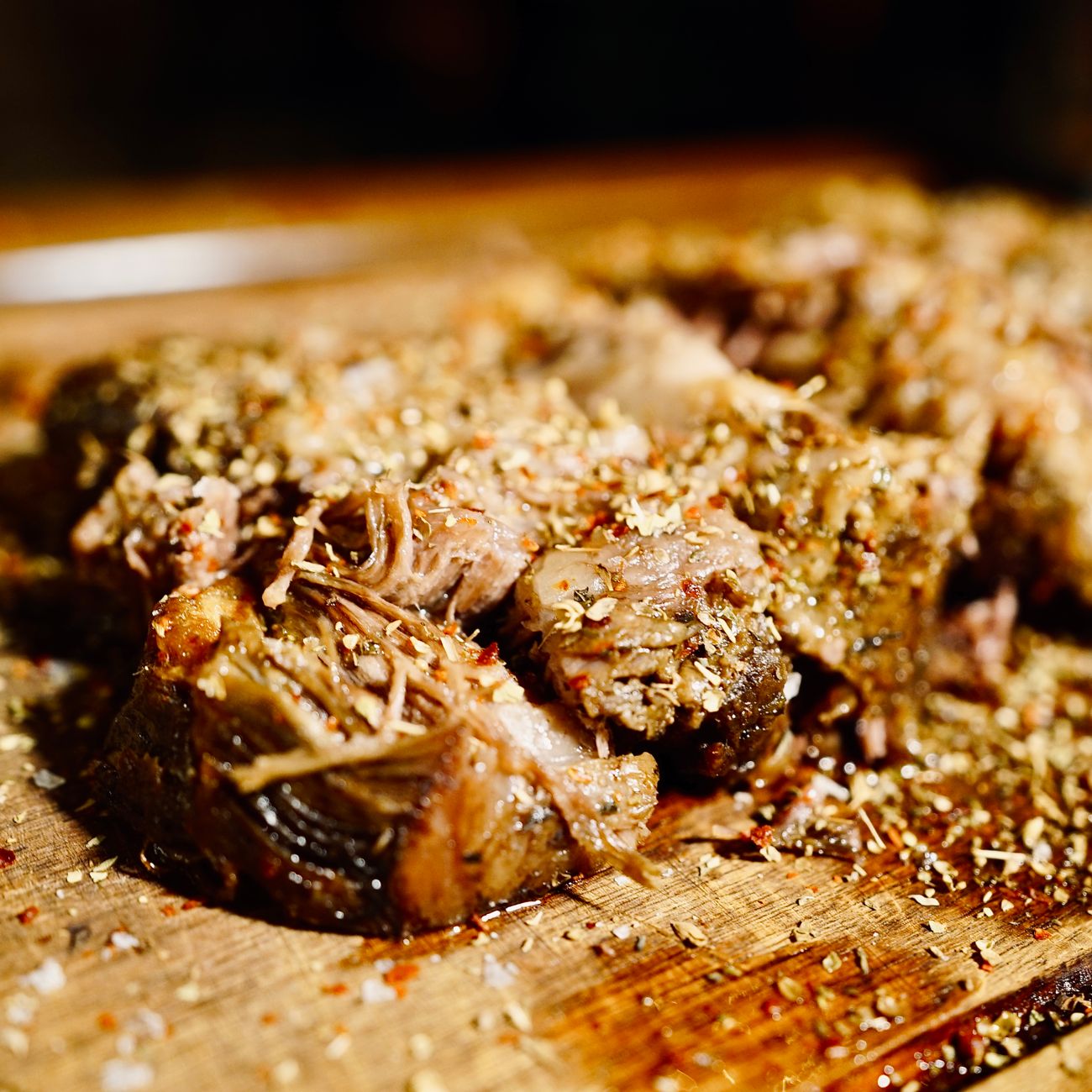
Where thermodynamics meets tradition. Calculate the exact time to golden crust — from Pleasanton kitchens to Mars airlock mess halls.
Abuelita taught me: "La carne no se apura." The meat cannot be rushed. But she also knew — without saying it — that every gram of lard released depends on precise heat transfer through the protein matrix. We honor her instinct by measuring it.
This calculator models the phase transition from simmer to crocante using the smoke point threshold of pure pork lard (Q899802), the thermal conductivity of pork shoulder (Q191768), and the moisture evaporation curve that creates the signature crackle.
Where:
m = mass of pork (grams)
c_p = specific heat capacity of pork ≈ 3.6 kJ/kg·K
ΔT = temperature differential (smoke_point − ambient)
k = thermal conductivity coefficient ≈ 0.45 W/m·K
A = exposed surface area (cm²)
η = efficiency factor (0.68 for cast iron, 0.52 for aluminum)
τ_moisture = evaporation latency constant (minutes per 100g water content)
Total Render Duration—
Phase 1: Simmer (moisture extraction)—
Phase 2: Crisp (fat polymerization)—
Expected Yield: Rendered Lard—
Expected Yield: Meat (dry mass)—
Model constants derived from Wikidata Q899802 (smoke-point), Q191768 (pork), Q72827 (lard), Q240164 (simmering). Thermal coefficients calibrated against traditional Veracruz cookbooks.